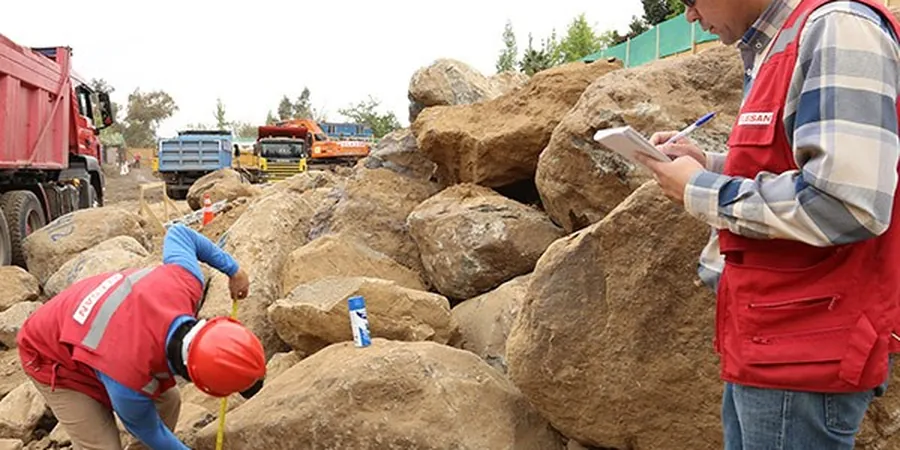
Launceston sits at an elevation of just 15 metres above sea level along the Tamar River, where the alluvial sediments and Tertiary basalts create highly variable ground conditions. A soil mechanics study is the only reliable way to characterise these layers before foundation design. In our experience, the transition from soft estuarine clays to weathered basalt can happen within three metres of depth, which makes a continuous sampling program essential. We combine borehole drilling with in-situ testing and laboratory classification to deliver a complete geotechnical model for your project. Complementing the soil mechanics study with a permeability field test helps identify drainage behaviour in these layered profiles, while liquefaction potential analysis is critical for sites near the river where loose saturated sands are present.
A soil mechanics study in Launceston must account for the abrupt transition from soft alluvial clays to weathered basalt within a few metres of depth.
Methodology and scope
What we see most often in Launceston is that the surface gravels and sands behave well under shallow footings, but the deeper clay layers require careful consolidation assessment. Our soil mechanics study includes index property tests such as natural moisture content, Atterberg limits, particle size distribution, and in-situ density. We follow AS 1726:2017 for all field and laboratory procedures. For projects on the steeper slopes of the Western Tiers foothills, we integrate a slope stability analysis to evaluate shear strength parameters under both drained and undrained conditions. Our approach is modular: we tailor the scope to your structure type, load requirements, and local geological setting. Each report includes a clear statement of the foundation bearing capacity, settlement estimates, and any constraints for excavation or dewatering.
Technical reference image — Launceston
Local considerations
A multi-storey residential building on the edge of the Tamar River floodplain encountered a 4-metre-thick layer of soft clay underlain by loose sand. Without a proper soil mechanics study, the design assumed uniform bearing capacity across the site. The actual variation meant differential settlements exceeded 50 mm within two years. Our investigation identified the clay’s high plasticity index and the sand’s low relative density, leading to a redesign with deep foundations. The cost of the soil mechanics study was less than 1 % of the remedial works needed afterward. The key lesson is that variable alluvial deposits demand a thorough site investigation before any structural design is finalised.
Borehole drilling with continuous sampling using SPT and undisturbed tube samplers. We install standpipes for groundwater monitoring and perform in-situ vane shear tests in soft clays. All samples are logged, sealed, and transported to our NATA-accredited laboratory.
02
Laboratory Classification & Strength Testing
Index testing (moisture content, Atterberg limits, particle size distribution), compaction characteristics (Standard/Modified Proctor), and shear strength parameters (triaxial UU, CU, direct shear). Results are interpreted in the context of Launceston’s alluvial and residual soil profiles.
Applicable standards
AS 1726:2017 – Geotechnical site investigations, AS 1289.3.1.1 – Atterberg limits determination, AS 1289.6.4.1 – Triaxial compression test, AS 1289.6.3.1 – Standard penetration test, NATA accreditation for geotechnical testing
Frequently asked questions
How long does a soil mechanics study take for a typical residential lot in Launceston?
For a standard lot with 2 to 3 boreholes to 5 metres depth, the field work takes one day. Laboratory testing and reporting add another 7 to 10 working days. If the site has deep fill or high water table, we may need additional time for consolidation testing.
What is the difference between a soil mechanics study and a geotechnical investigation?
A soil mechanics study is the laboratory component of the broader geotechnical investigation. The field work (boreholes, sampling, SPT) is part of the site investigation, while the soil mechanics study covers the index and strength tests performed on the samples in the lab. Both are integrated into a single geotechnical report.
What is the typical cost of a soil mechanics study in Launceston?
The cost ranges between AU$4,240 and AU$7,150 for a standard residential study including 3 boreholes to 5 metres, index testing, and a bearing capacity report. Larger commercial projects with deeper boreholes, triaxial testing, and consolidation can exceed AU$15,000. Contact our team for a quote tailored to your site.
Do I need a soil mechanics study for a house extension in Launceston?
Yes, if the extension involves additional load on existing footings or is located within 3 metres of the original building. The Launceston City Council may require a geotechnical report for developments in flood-prone or hillside areas. A soil mechanics study confirms the ground can support the new load without excessive settlement.