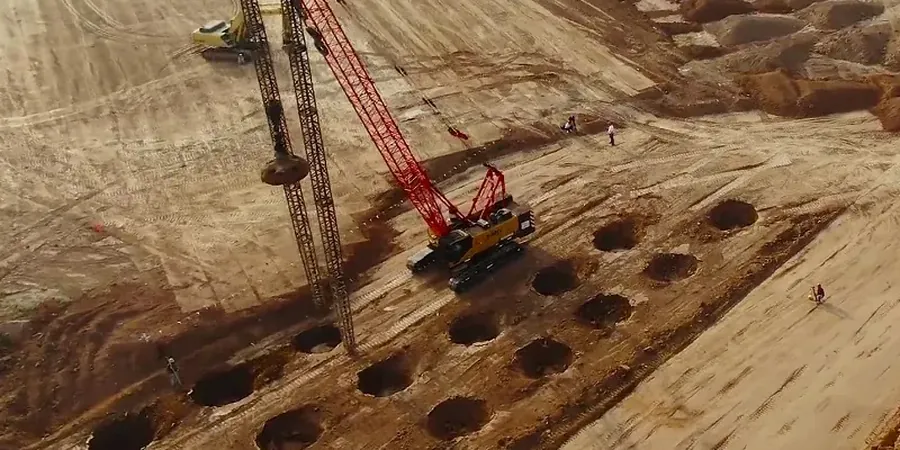
The heavy tamping rigs used for dynamic compaction in Launceston typically deliver a 10 to 20 tonne weight from drop heights of 12 to 25 metres. This process densifies granular soils and fills to depths of 6 to 10 metres in a single pass. In Launceston's alluvial plains near the Tamar River, where variable fill and soft estuarine deposits are common, the impact energy must be tuned to avoid over-compaction or disturbance of sensitive clays. Before mobilising the crane, we run a preliminary site investigation including [MASW surveys](/masw-vs30/) to map stiffness contrasts across the site and identify optimal grid spacing for the compaction points.
Dynamic compaction in Launceston demands precise energy calibration: too little and loose fills remain unstable, too much and underlying clays can shear.
Methodology and scope
Soils in the Kings Meadows area tend to be denser sandy gravels, whereas the Inveresk precinct sits on deeper soft clays and loose silty sands. Dynamic compaction design must account for these contrasts. For Kings Meadows, a 15-tonne weight dropped from 18 metres on a 4-metre grid typically achieves 70% relative density. At Inveresk, the same energy could trigger lateral displacement or pore pressure buildup. We combine the compaction plan with deep soil mixing for zones where fines content exceeds 25%, ensuring consistent bearing capacity across the site. Key parameters we assess:
Drop weight mass and fall height
Grid spacing and number of passes
Energy per unit volume (typically 200–400 kN·m/m³)
Post-treatment verification with CPT or SPT
Technical reference image — Launceston
Local considerations
AS 4678:2002 for earth retaining structures and AS 1726:2017 for geotechnical site investigations guide our risk assessment. In Launceston, the main hazard is lateral spreading of saturated loose sands under dynamic loading. The city's moderate seismicity (AS/NZS 1170.4 zone factor Z = 0.08) means compaction-induced liquefaction of existing loose fills is a real possibility. We design buffer zones around adjacent structures and install vibration monitoring. A typical exclusion radius is 10 to 15 metres for heritage buildings common in the city centre.
Complete design including energy calculation, grid layout, pass sequence, and post-treatment testing. Includes site-specific FEM modelling for adjacent settlement and vibration prediction.
02
Compaction verification program
Field testing with CPT or SPT before and after compaction. We report relative density gains, bearing capacity improvement, and provide a stamped certification for the engineer of record.
Applicable standards
AS 4678:2002, AS 1726:2017, AS/NZS 1170.4:2007, AS 1289.6.3.1 (SPT verification)
Frequently asked questions
What is the typical cost range for dynamic compaction design in Launceston?
For a standard 1,000 m² site, the design and verification package ranges between AU$1,730 and AU$4,200. Larger or more complex sites with multiple passes or adjacent structures can run from AU$4,200 to AU$7,400. These figures exclude contractor mobilisation and drop weight operation.
How deep can dynamic compaction treat soils in Launceston?
Effective depth depends on drop weight and fall height. With a 15-tonne weight dropped from 20 metres, we typically achieve 7 to 9 metres in loose sands and gravels. For deeper treatment, heavier weights up to 20 tonnes extend the zone to about 10 metres. Fine-grained soils with high silt content require alternative methods such as deep soil mixing.
Is dynamic compaction suitable for Launceston's clay soils?
Not directly. Dynamic compaction works best in free-draining granular soils. In Launceston's clay-rich zones, especially around the Tamar River floodplain, the impact energy can cause pore pressure buildup and remoulding. We assess soil type via preliminary boreholes and recommend deep soil mixing or surcharging for cohesive fills.
What post-treatment testing do you recommend after compaction?
We typically run CPT or SPT at midpoints between compaction points to verify relative density. For bearing capacity verification, plate load tests (300 mm and 600 mm diameter) are standard. If liquefaction mitigation is the goal, we also perform vs30/" data-interlink="1">shear wave velocity measurements using MASW to compare Vs30 before and after treatment.